Date & running-hour jobs
Schedule recurring work, manage rules, view due status, complete, postpone, reopen, and retain history.
Planned Maintenance System
Schedule vessel maintenance, record defects, track spares, and manage approvals in one workspace. Crews work offline onboard; shore teams review updates after sync.
Product preview · sample fleet data
See open defects and their current status.
Find the vessel, component, and person responsible.
Where cost leaks
Paper can record work. Altonaut connects the record to the next action across a fleet.
Due jobs buried in vessel files
Fleet view of due, overdue, and critical work
Defects discussed across chat threads
Status, evidence, owner, and closure history together
Spare requests detached from maintenance
Parts and service demand linked to operating context
Management reports rebuilt by hand
Current data available for review and export
Connected fleet operations
Follow each job from planning and crew records through spare parts, approvals, and completion.
Schedule recurring work, manage rules, view due status, complete, postpone, reopen, and retain history.
Manage standard and vessel components, criticality, condition, running hours, documents, and fleet templates.
Capture findings, component, failure mode, status, media, actions, and a traceable closure path.
Track stores and spare parts by vessel and department, stock movement, monthly history, and item usage.
Create requisitions, collect prices, route approvals, generate orders, and retain status and attachment history.
Review scheduled, completed, overdue, and postponed work from fleet summary down to vessel detail.
Manage certificate templates, vessel documents, survey status, revisions, media, and expiry notifications.
Record events, investigations, corrective actions, audit checklists, findings, evidence, and fleet-level KPIs.
Use core vessel workflows locally, preserve queued work, then synchronize when a connection is available.
Inside Altonaut
Explore equipment, defects, procurement, inventory, and QHSE from the same fleet workspace.
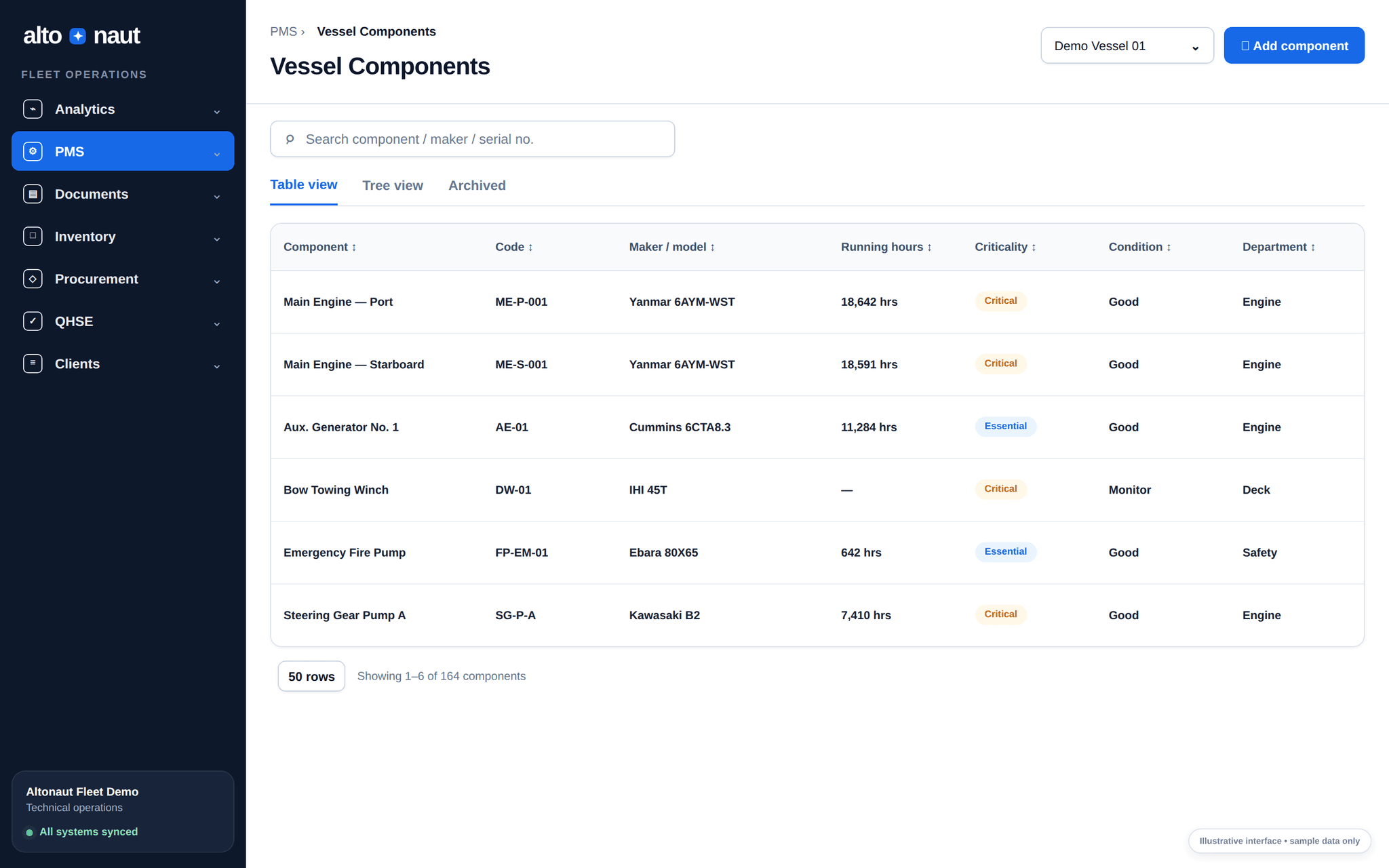
Search, filter, archive, export, and inspect equipment across vessels.
Value by role
Owner / Director
See readiness risk, delayed decisions, and maintenance cost signals across the fleet.
Technical Team
Focus on overdue critical work, repeat defects, vessel condition, and closure evidence.
Procurement / Finance
Trace why a purchase is needed, who approved it, and where the part or service is used.
Master / Chief Engineer
Execute work and hand over clear history without rebuilding the same report twice.
See where your fleet carries avoidable cost
Use your own fleet records to see where team time, emergency purchasing, disruption, and inventory loss are costing you today. Your pilot will track these same measures.
Build your fleet baseline
Enter figures from your operation to estimate the selected annual costs. Use this as a starting point for measuring change during a pilot.
Use the 12-vessel example as a starting point, then replace every input with your records. The result becomes your comparison point for the pilot.
Add annual costs your team can verify per vessel
Enter a typical annual amount for one vessel. We multiply it across the vessels in scope. Use operating and finance records, and keep each incident in one category.
Typical annual expedited parts, emergency orders, and premium freight for one vessel.
Typical annual avoidable delay, off-hire exposure, or operational disruption for one vessel.
Typical annual duplicate purchases, expired stock, count variance, and write-offs for one vessel.
Estimated annual costs in scope
Selected annual costs
Rp 4.003.200.000
Selected annual costs / vessel
Rp 333.600.000
These are estimated current costs, not promised savings. Agree which costs to track before a pilot, then compare the results.
This is your planning baseline, not a savings guarantee. During the pilot, you will compare the same measures and see which changes are linked to Altonaut.
A 45-day path to rollout
Run a 45-day pilot with your own vessel data. No monthly software subscription charge during the pilot. Setup/onboarding scope and any fees are confirmed in the quotation before the pilot starts.
Choose one vessel and agree the setup, training, included workflows, and success criteria.
Use the Planned Maintenance System with your own vessel data. No monthly software subscription charge during the pilot.
Review crew adoption and maintenance visibility. Agree commercial terms before rolling out to more vessels.
Start with one vessel, run a 45-day pilot, and agree next steps from the evidence.